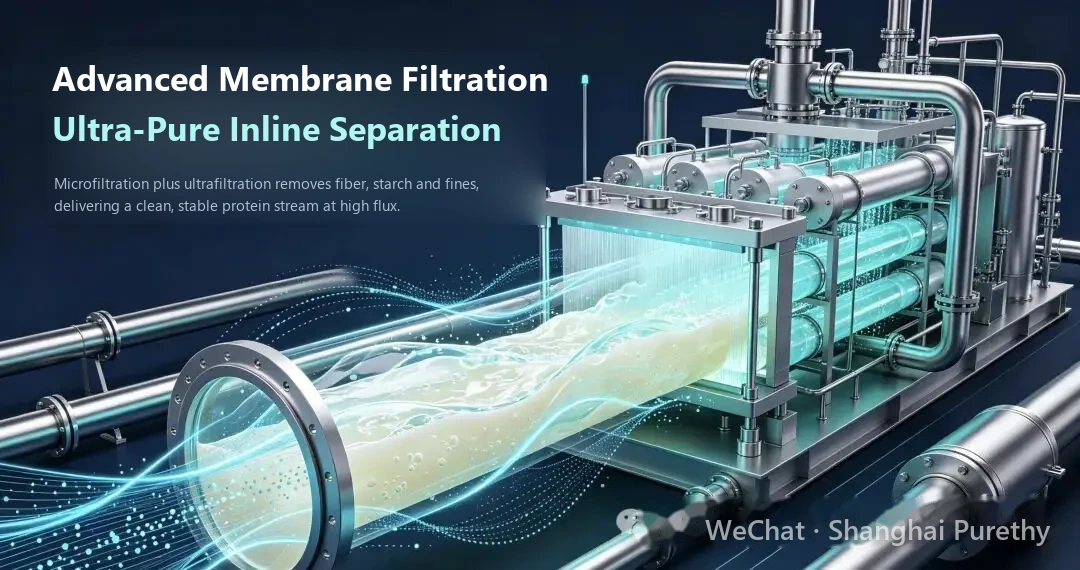
As the plant-based ingredient industry expands rapidly, demand is rising for efficient protein separation technologies that can run at industrial scale without heavy reliance on chemical extraction. Conventional protein separation usually involves multiple precipitation, washing and pH adjustment steps, which drive up water and energy consumption and make the process increasingly complex. Such multi-batch, intermittent systems also tend to damage the functional properties of proteins, so quality varies from batch to batch and the process fits poorly with highly automated food manufacturing.
Membrane filtration offers another route: a pressure-driven, physical separation of plant protein fractions that requires no heavy chemical treatment. By pairing microfiltration and ultrafiltration units within a continuous inline process, producers can separate and concentrate proteins while keeping material flowing steadily throughout. This approach removes batch handling steps, reduces water and chemical consumption and improves process stability. As food manufacturers place greater emphasis on clean-label production, resource efficiency and continuous operation, membrane-based separation systems are playing an increasingly critical role in large-scale plant protein production.
How Membrane Separation Works for Plant Proteins
.webp "Microfiltration and ultrafiltration membrane separation")
Industrial plant protein separation generally runs microfiltration followed by ultrafiltration to separate protein from the fibre, starch, sugars and soluble solids in the feed slurry. During processing, the slurry passes across a semi-permeable membrane surface under controlled pressure. The microfiltration stage retains large suspended particles and insoluble fibre, while smaller soluble matter and protein-rich fractions pass through to form the permeate. The permeate then enters ultrafiltration, where the membrane retains large protein molecules while water, salts, sugars and other low-molecular-weight substances pass through, leaving a concentrated protein product.
Whether separation stays consistent depends heavily on how well transmembrane pressure, flow velocity and membrane condition are controlled throughout the process. Dead-end filtration quickly causes solids to build up on the membrane surface, so most industrial systems use cross-flow filtration, in which the feed flows parallel to the membrane to limit cake build-up and maintain flux. Even with cross-flow operation, membrane fouling, viscosity-related pressure loss and localized gel layer formation remain the main production challenges. These effects alter the shear environment and reduce permeate flux as production continues, so continuous operation requires carefully scheduled cleaning cycles and feed velocity adjustments to keep filtration efficiency stable.
Process Optimization and Filtration Prediction Models
To limit the capacity loss caused by fouling, plants use real-time monitoring and process simulation to track parameters such as transmembrane pressure, feed flux and flow resistance. The system can identify cake layer formation or pore blocking early, allowing operators to adjust cross-flow velocity, pressure settings or backwash intervals accordingly. Data-driven process control improves stability and moves maintenance away from purely fixed-interval schedules.
Biochemical pretreatment and high-performance membrane materials can also improve filtration efficiency. Enzymatic pretreatment uses carbohydrases or proteases to break down complex carbohydrates and soluble fibre in the slurry, lowering its viscosity. Lower viscosity helps prevent a dense gel layer from forming on the membrane, sustaining higher permeate flux and stable protein recovery. In addition, new hydrophilic-coated and ceramic membranes reduce protein adsorption and lower the risk of irreversible fouling. These materials tolerate a wide pH range and aggressive cleaning, and their pore structure remains stable over long production runs.
Scaling Membrane Separation to Industrial Production
.webp "Industrial membrane filtration skid")
Scaling membrane separation from laboratory and pilot trials to industrial output requires precise control of hydrodynamics, pressure distribution and overall system architecture. Commercial lines consist of large multi-stage filtration loops and arrays of parallel membrane modules that run continuously at high flux. Keeping transmembrane pressure balanced across the system avoids localized fouling, uneven protein concentration and inconsistent separation. Stable filtration conditions help ensure a consistent nutritional profile, texture and binding functionality in large production volumes.
Compared with conventional chemical extraction, scaled membrane processing offers clear sustainability advantages. Conventional extraction generates large volumes of high-COD wastewater, and washing steps consume substantial amounts of water. Permeate from membrane filtration is cleaner and can be recirculated within the production line. Water and soluble minerals separated during ultrafiltration can be reused to reconstitute the feed slurry, cutting water use and operating costs. This closed-loop model helps producers meet environmental regulations while improving resource efficiency.
Inline continuous membrane filtration systems connect directly to automated production lines. Batch extraction requires holding tanks and runs intermittently, whereas a continuous filtration loop keeps material moving steadily from slurry feed through to protein concentration. Continuous operation supports real-time monitoring and automated quality control, with inline sensors detecting abnormal fluctuations in flow rate, concentration and pressure as they occur. Less manual intervention and fewer intermediate storage steps translate into higher capacity, better product consistency and more reliable production.
Emerging Multi-Component Extraction
Beyond extending equipment life, newer production systems are moving toward multi-stage, multi-component extraction to maximize raw material utilization. Most current equipment recovers only a single target protein, so valuable secondary proteins, bioactive peptides and specialty carbohydrates are lost in the waste stream. With an integrated multi-stage membrane loop, plants can separate useful fractions step by step using precise molecular weight cut-off thresholds.
This model upgrades conventional separation into a biorefinery process: different fractions can be separated and supplied to a range of downstream applications without building multiple energy-intensive, dedicated lines. Recovering multiple co-products from the same raw material opens additional revenue streams and further improves the economics of continuous membrane filtration lines.
Adaptive Automation and Advanced Material Recovery
.webp "Sensor-controlled adaptive membrane filtration")
The next step for membrane-based ingredient recovery is the intelligent filtration system, which combines real-time sensing with adaptive process control. Pressure, flow and viscosity sensors installed across the membrane modules let the automation system adjust feed pressure, cross-flow velocity and cleaning intervals in real time as slurry conditions change. This dynamic control improves filtration stability, reduces fouling risk and keeps protein recovery consistent over long production runs.
At the same time, high-performance membrane materials and low-energy separation technologies continue to advance, steadily improving industrial efficiency and environmental performance. Durable ceramic membranes, modified hydrophilic coatings and multiphase flow simulation models help extend membrane service life while reducing energy use and cleaning frequency. As food manufacturing places more weight on resource efficiency, production automation and product consistency, membrane filtration will become a core element of large-scale material recovery and continuous food processing lines.
 AI Assistant